

In the fast-paced world of aviation, visual communication is everything. While passengers easily recognize the gold bars on a captain’s shoulder, fewer people understand the rich history and strict hierarchy behind Aircraft Engineer Epaulettes.
Whether they are called epaulettes, stripes, or bars, these shoulder marks are far more than mere uniform ornaments. They are vital symbols of regulatory authority, legal signing power, and professional pride on the hangar floor and the tarmac.

What Are Aircraft Engineer Epaulettes?
Aircraft engineer epaulettes are specialized fabric slides or shoulder boards worn on the tabs of white pilot-style (navigator) shirts, jackets, or high-visibility vests.
Historically rooted in military and maritime traditions, epaulettes serve as an immediate visual hierarchy in the aviation industry. They allow flight crews, ground handling teams, and station managers to immediately identify an individual’s rank, experience level, and certification authority.
The Uniform Debate: Pride vs. Practicality
In recent years, some low-cost carriers and ground-handling organizations have eliminated epaulettes for positions like aircraft dispatchers and line mechanics, shifting toward casual polo shirts or standard high-visibility overalls.
However, major network airlines and large Maintenance, Repair, and Overhaul (MRO) facilities actively maintain the traditional uniform code. For licensed engineers, wearing their stripes is a deep source of professional pride, representing years of rigorous examinations and immense legal responsibility for airworthiness.
The Symbolic Colors of Aviation Engineering
Unlike pilots, who universally wear gold or silver stripes on a plain black or navy background, aircraft engineers carry distinct design variations that honor the history of marine engineering:
- The Royal Purple Tradition: The most iconic engineering epaulettes feature gold stripes with purple spaces or backing. This traces back to maritime history, honoring the engineers who stayed at their posts to keep the power running. Some airlines substitute maroon for purple.
- The “E” and Spanner Insignia: To ensure absolute distinction from flight crews, many engineering organizations embroider a gold letter ‘E’ or a spanner/wrench icon onto the shoulder board.
- The Dispatcher Contrast: While aircraft dispatchers traditionally wear red and gold stripes, engineering teams stick to silver/gold and purple/maroon combos to keep the tarmac operations clear and error-free.
Decode the Rank: What Do Engineering Stripes Mean?
There is no universal, worldwide standard for aviation engineering ranks, as each airline or MRO dictates its own internal system. However, organizations look at two key factors to determine hierarchy: the number of stripes and the thickness of the bars.
Here is a common operational breakdown of how engineering grades are distributed:
1. Executive Management & Station Leaders (4 Thick Bars + Icons)
The highest tier on the tarmac. Four thick gold bars—often accompanied by a star, a crest, or a distinct letter ‘E’—are awarded to Shift Managers, Base Maintenance Managers, Hangar Managers, and Chief Engineers. These individuals carry ultimate administrative and operational oversight.
2. Senior Licensed Aircraft Engineers / LAE (4 Thick Bars)
Four thick gold or silver stripes without extra symbols usually represent a Senior Licensed Aircraft Engineer (LAE). These professionals hold comprehensive company authorizations to issue a Certificate of Release to Service (CRS) for complex, multi-engine aircraft tracks.
3. Junior Certifying Engineers (3 Bars or Mixed Thickness)
Three gold stripes typically identify a Junior Licensed Aircraft Engineer. In advanced ranking setups, this tier might also be represented by a combination of thick and thin bars (e.g., one thick bar and three thin bars to indicate a newly approved certifying engineer).
4. Lead Technicians & Cat A Certifiers (2 Thick Bars + Thin Bars)
The two-stripe tier generally belongs to highly experienced, non-certifying personnel or limited certifiers.
- Two Thick Bars + Two Thin Bars: Often denotes a Lead Technician running a specific hangar team.
- Two Thick Bars: Typically represents a Senior Aircraft Technician, a Category A certifier, or a specialized aviation Storekeeper.
5. Trainees and Students (1 to 3 Thin Bars)
Progressing from one to three thin, narrow bars allows an organization to track the tenure of Aircraft Maintenance Students, Trainees, and Unlicensed Mechanics during their hands-on logbook years before they clear their basic license exams.
Aircraft Engineer vs. Pilot Epaulettes: Key Differences
| Feature | Pilot Epaulettes | Aircraft Engineer Epaulettes |
| Primary Stripe Colors | Gold or Silver | Gold or Silver paired with Purple/Maroon |
| Base Fabric | Solid Black or Midnight Navy | Black, Dark Blue, or Textured Charcoal Grey |
| Insignia Symbols | Star, Wings, or Anchor | Letter ‘E’ or Spanner/Wrench icons |
| Operational Purpose | Denotes flight command hierarchy | Denotes regulatory release & certification authority |
Typical vs. Advanced Engineering Epaulette Ranking Systems
When establishing a visual hierarchy for ground and hangar operations, airlines generally choose between standard simplicity or highly granular, tenure-driven progression. Below is a comparison of how different organizations structure their engineering ranks.
Airline A: The Standard Framework (e.g., AirAsia Model)
This is a streamlined, industry-standard approach designed for quick identification on the tarmac. It focuses primarily on broad job roles and licensing milestones, keeping the visual layout completely simple:
- 1 Bar: Trainee Mechanic / Junior Technician (Entry-level staff under direct supervision)
- 2 Bars: Aircraft Technician / Mechanic (Experienced hands-on technical personnel without full release privileges)
- 3 Bars: Licensed Aircraft Engineer / LAE (Certifying staff holding Category B1 or B2 licenses with full legal authority to sign the Certificate of Release to Service)
- 4 Bars: Lead Engineer / Shift Supervisor / Maintenance Manager (Highest rank on the floor, carrying ultimate operational and safety responsibility for the shift or station)
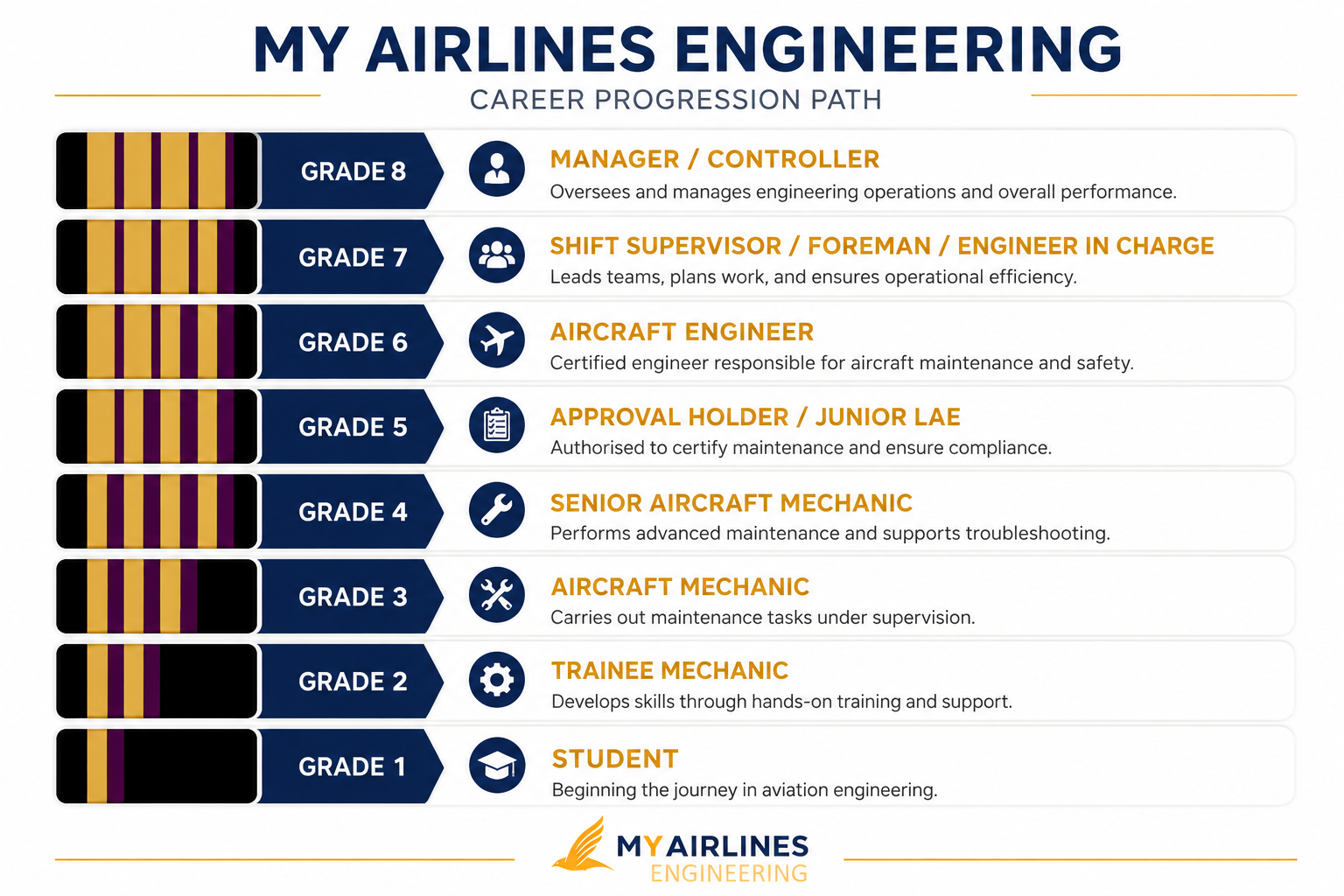
Airline B: The 8-Grade Advanced Framework
This system introduces a slightly more complex, mathematical progression. It utilizes a fixed total cluster width and a combination of thick and thin gold bars to map out precise career tenure, specific hands-on milestones, and the transition from mechanical support to legal authorization:
- Grade 1 (Student): 1 thin gold bar with purple backing.
- Grade 2 (Trainee Mechanic): 2 thin gold bars.
- Grade 3 (Aircraft Mechanic): 3 thin gold bars, signifying 2 years of hands-on experience.
- Grade 4 (Senior Aircraft Mechanic): 4 thin gold bars, representing 5 years of experience and an un-typed basic Aircraft Maintenance License (AML).
- Grade 5 (Approval Holder / Junior LAE): 1 Wide Gold Bar + 3 Thin Gold Bars. The exact moment company approval is granted, the first bar becomes thick, instantly signaling legal signing authority on the tarmac.
- Grade 6 (Aircraft Engineer): 2 Wide Gold Bars + 2 Thin Gold Bars, representing 2 years of active certifying experience.
- Grade 7 (Shift Supervisor / Foreman / Engineer in Charge): 3 Wide Gold Bars + 1 Thin Gold Bar, commanding immediate operational authority over a station.
- Grade 8 (Manager / Controller): 4 Full Wide Gold Bars, representing ultimate administrative and fleet airworthiness control.
Future of the aircraft engineer Uniform
As digital maintenance logs, biometric ID badges, and smart high-visibility gear dominate modern aviation, the physical epaulette is evolving.
While the daily hands-on grease work is performed in heavy-duty overalls or t-shirts, the traditional epaulette shirt remains an irreplaceable asset for line maintenance outstations, client-facing handovers, and corporate management reviews. For traditional airlines, these bars will always stand as an enduring symbol of safety, technical expertise, and airworthiness excellence.
References & Further Reading:
Standard Commercial Aviation Uniform Protocols: Differentiating Flight Crews from Ground Engineering Teams.
EASA Annex IV (Part-66) – Aircraft Maintenance Licensing Requirements and Certification Privileges.